
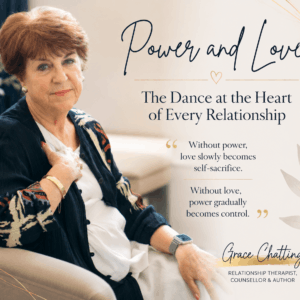
Power and Love: The Dance at the Heart of Every Relationship
For many years, I believed that if only we could love enough, relationships would work.
It seems almost naïve now, but I suspect I am not alone in that belief. Many of us grew up on a steady diet of stories, films, songs and cultural messages that taught us that love conquers all. If we were kind, patient, understanding and forgiving enough, surely everything would somehow fall into place.
Looking back, I can see how profoundly that message shaped my life and the lives of many of the women I have worked with over the past forty years.
The problem is not that these qualities are unimportant. Compassion, patience, generosity and understanding are essential ingredients of a healthy relationship. The difficulty arises when we mistake them for the whole recipe.
Love alone is not enough.
What I have come to understand, both through my own life and through thousands of conversations in the therapy room, is that every healthy relationship requires another force alongside love. Adam Kahane, in his remarkable book Power and Love, describes these as two fundamental human drives. Love is our longing for connection, belonging, compassion and unity. Power is our capacity for agency, self-expression, purpose and choice.
When I first encountered this idea, it immediately illuminated something I had observed repeatedly in relationships. Most people are not struggling because they lack love. More often, they are struggling because the relationship has lost its balance between love and power.
The word power can be uncomfortable, particularly for women of older generations. Many of us were raised to be accommodating rather than assertive, helpful rather than self-focused, agreeable rather than challenging. Power was often associated with domination, aggression or selfishness. It seemed somehow at odds with being loving.
Yet healthy power has very little to do with control.
Healthy power is knowing who you are. It is being able to recognise your own needs, values, limits, and desires, and to communicate them clearly. It is the capacity to say yes when you mean yes and no when you mean no. It is the willingness to remain connected to another person without abandoning yourself.
Without power, love slowly becomes self-sacrifice.
SIGN UP TO MAILING LIST
Without love, power gradually becomes control.
The challenge of every intimate relationship is learning how to honour both.
Over the years, I have noticed that many people naturally lean towards one side of this polarity. Some are deeply oriented towards love. They value harmony, closeness and connection. They are highly attuned to the emotional atmosphere around them and often feel responsible for maintaining peace. They become skilled at understanding other people’s feelings but less so at recognising their own.
Others are naturally inclined towards power. Independence matters deeply to them. They value autonomy, freedom and self-determination. They may feel constrained by excessive emotional intensity or view closeness as a threat to their sense of self.
Neither position is incorrect. Both are expressions of essential human needs.
Difficulties arise when one side becomes overdeveloped and the other neglected.
This is where Kahane’s distinction between generative and degenerative forms of love and power becomes particularly helpful.
Generative Love
Generative love is the kind of love that creates connection whilst still respecting individuality. It allows us to care deeply about another person’s experience without losing sight of our own reality. It creates emotional safety whilst encouraging honesty, growth and accountability. In generative love, we can disagree and remain connected. We can be compassionate without becoming responsible for another person’s choices.
Degenerative love often looks very different, although it can be difficult to recognise because it frequently masquerades as devotion.
I have seen this pattern countless times in women(and men!) who loved too much.
They become experts in understanding, helping, fixing, supporting and forgiving. They wait patiently for change. They explain away behaviour that hurts them. They rescue their partner from consequences. They minimise their own disappointment and silence their own needs in the hope that enough love will eventually transform the situation.
At first glance, this can appear extraordinarily loving.
In fact, something much more painful is happening.
The love has become disconnected from self-respect.
What begins as compassion gradually turns into self-abandonment.
One person’s needs begin to fill all the available space in the relationship, whilst the other’s become increasingly invisible. The tragedy is that this weakens both partners. One loses oneself. The other loses the opportunity to grow.
SIGN UP TO MAILING LIST
The same distinction applies to power.
When power is generative, it creates clarity, dignity and mutual respect. It allows us to establish healthy boundaries, make conscious choices and communicate honestly. It is the ability to say, “I love you, and this still matters to me.” It is the courage to remain present whilst speaking our truth.
Generative power is not about getting our own way. It is about bringing our authentic self into the relationship.
When power becomes disconnected from love, however, it takes on a very different quality.
Degenerative power seeks control rather than collaboration. Sometimes it appears as overt dominance, criticism or intimidation. More often, it shows up in subtle ways. It may be emotional withdrawal, chronic disapproval, controlling finances, unilateral decision-making or creating an atmosphere in which one partner feels they must constantly seek permission or approval.
Gradually, one person grows larger whilst the other grows smaller.
The relationship ceases to be a partnership and becomes a hierarchy.
And that is where intimacy begins to die. ☹
If you’re neurodivergent, navigating love can feel more challenging. Read my book Navigating Love Relationships and ADHD for more advice and guidance.
Wondering what to read next? Why not try Waking Up from Love Addiction: When Loving Too Much Becomes Losing Yourself